Dear Diary…

Writing in a diary is precious, isn’t it? The first time I realised its beauty I was reading The Diary of Anne Frank. Born into a Jewish family in Hitler’s Germany, Anne maintained a diary during the few years she and her family were hiding from captivation. Her father, the only survivor of the concentration camp that wiped out the family, published her diary. To this day it remains a stunning reminder and a heart-wrenching portrayal of the life of a teenager in wartime.

It was the emotions and the ultimate simplicity of that diary that inspired me to start writing my own diary. Every day I’d record my thoughts, frustration, observations, and general musings. When I looked at the entries months afterwards, I noticed a lot of silly mistakes. But I also saw a lot of potential and my true self coming out of the diary. That’s how I understood so many aspects and characteristics of myself. It was so sincere and so flippant that I saw myself for the first time.

I loved what I discovered so much so that I incorporated diary entries as part of a story I wrote. I had a couple of chapters dedicated to diary entries of my main characters. And I felt the difference, too. I dug deep into the character to extract their innermost emotions, because the diary of a character speaks truer words about them than the character themselves. It’s so because diaries are for personal readership. Anyone who keeps a journal knows that no one would and should read it but themselves. That gives them immense confidence to be themselves and let their guard down.

I did. That’s why I managed to impress myself so. It’s the same of anyone else. Because we know it’s private, we allow ourselves to be real. We charade our true emotions and opinions in public for fear of people hating or misunderstanding them. While we project what we want to project to the world, a diary is where we take a break and project our actual thoughts.

During a particular rough time in my life, I was so self-pitying. No one else who met me would’ve known that at the time. I didn’t realise it myself—until months later I read what I’d written in my diary. It’s such a harsh way of telling yourself who you are and I think that’s a pretty powerful technique in storytelling.

I just started reading a book that’s made up of nothing but diary entries. I’ve only read about 50 pages but I already see the depth at which a journal characterises the person. I see two different personalities in the same journal entry—one when the character narrates what they did in public, and the second when the character writes down how they felt at that moment. There’s a lot of interesting juxtaposition and a beautiful arc of a story.

Although it’s so good so far, I wonder if it’d get boring as the story progresses. Too much of a good thing, perhaps? I can’t wait to find out.
Start with you

Time and energy are our primary assets. How we use them defines the purpose of our lives. More often than not, however, we expend them on achieving matetrial goals like building a house or buying a car. Throughout our lives, we hustle and struggle to acquire things that we may never enjoy. People say a house is an investment. And so they allocate up to 25 years worth of their labour to paying off housing loans. Sure, it’s beneficial while calculating tax, but at the end of 25 years, when the house becomes theirs for real, it’s just another asset they pass on to the next generation.

My point—we invest so much of our time and energy on physical matters while we should be investing on our mental and spiritual health, instead. It’s what we do for ourselves that completes our existence. That’s what we should all be focussing on: ourselves. That’s not to say we should embrace a narcissistic personality, though. It’s, instead, prioritising our psychological needs engaging in activities that fill our heart with joy and soul with compassion. Unless I invest in my happiness, I wouldn’t feel content with my life.

That’s why we should never regret doing things for ourselves. It’s not only our right but also a duty to nourish our soul. Whether it’s rereading a favourite book, dining out with a close friend, or spending time with a family member, it’s important to do more of what makes us happy.

Only when we’re happy from within do we emit the same joyousness. When we’re satisfied with ourselves, we seek to share the same triumph with our surrounding. When we love ourselves, it transcends to others as well.

And that’s why I believe we shouldn’t ever apologise for starting with ourselves.

In search of utopia

I always choose comfort first—in attire, in stance, and even in the company I keep. And when it comes to my everyday life, I don’t have many surprises. My day begins the same way every day and ends in the same way. Throughout each day, I focus on things that matter most to me—tasks I enjoy, tasks I’d be willing to repeat.

As a result, I’ve grown comfortable with a certain lifestyle. It’s my zone, my happy place, and I don’t appreciate disturbances in that.

As attractive as it sounds, there’s also the risk of becoming too comfortable. I realised this while replying on a Twitter chat. Sometimes we get so accustomed to what makes us happy, like certain choices and routines that we’d rather not break out of. Most often than not, that’s because we prefer to be happy with whatever we like instead of putting ourselves out there and exploring new opportunities.

That’s how we let great opportunities slip through our fingers. Even if we realise that a new choice or a new job offers more potential for growth, we still choose to stay where we are… because that’s the easier option. And the longer we train our minds to satisfy itself with whatever—little or much—it possesses, the harder it becomes for us to venture into newer experiences. As the combination of fear and laziness builds up, inertia creeps up on us even before we know it.

As our fear to try out new things increases, we begin to focus more on the task at hand rather than the purpose of it. We care more about completing the routine than about the satisfaction it brings us. We start to define our self-worth based on the destination rather than the journey. That’s when routines become lethal. When our journey lacks passion, our life lacks soul, too. We become afraid of unfamiliarity, associating it with discomfort. We hesitate to make decisions, and douse in doubt even when we do. And with doubt tags along the inability to forgive ourselves for our mistakes and accept embarrassment.

And all of a sudden, what once was comfortable would’ve reduced us to nothing but scrawny scared cats. Staying in the comfort zone is as handling a two-sided sword. We just have to find the right balance.

Self, thy name’s Esther

The first time I read a few lines attributed to her, I fell in love with Sylvia Plath. Thanks to the collection board that’s Pinterest, I discovered plenty of gut-wrenching, heart-clenching verses that Plath had written. Hooked, I went on a rampage of Sylvia stalking. Before I knew it, she’d become one of my favourite writers. I’d read about her curious suicide, and I’d watched Gwyneth Paltrow’s portrayal of her life. Her story strengthened my affection for her and somewhere between feeling respect and pity towards her, I found myself doting after her as well.

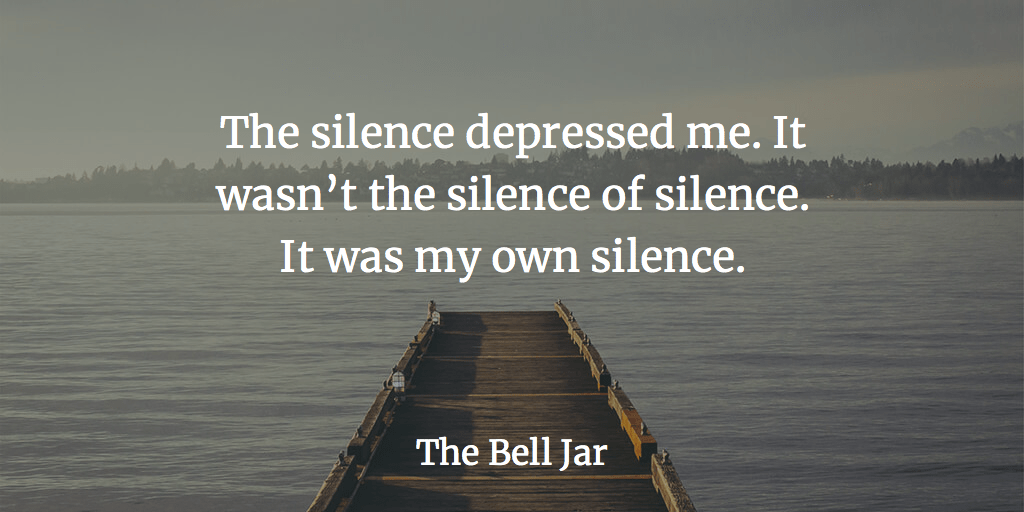
Wonderful though it all was, I’d become addicted to Plath despite reading none of her works in complete. That’s how I came upon The Bell Jar—guilt-ridden and hungry to prove to myself that I know the author I adored.

Before flipping through its pages, I didn’t know what to expect from The Bell Jar. Wanting to figure it out for myself, I read none of the reviews and asked no one I know what they thought of the story. As I began reading, I grew fascinated by the protagonist of the story, Esther Greenwood. The reason, I later realised, is that she’s in no way special. Unlike many other protagonists with their exceptional talents shining through print, Esther was simple in all sense.

The book opens with her in the middle of a writer’s scholarship—something I could appreciate as an aspirer myself. Little by little, as the story progressed, I found parts of myself relating to Esther. She reminded me of my deeper self—the unassuming, uninterested self that often prefers solitude, dabbling in self-doubt and incessant imposter syndrome.

It was later that, as the narrative turned to Esther’s psychological issues, I understood that Esther isn’t just me, but she’s every other person, too. Not only was her behaviour characteristic of me, but she was also an embodiment of the natural evolution of the teenage mind.

It’s not easy growing up, and it’s even more difficult when you’re alone and lacking guidance. That’s most of us. That’s Esther.

That’s why it became tough to separate myself from the character. I became so involved in her life that I wanted to see how each day of her life unfolded. As she cringed, so did I. As she ran away from accepting herself, as did I. I followed her every move, her every decision and instinct as if it would all affect my life in a way.

It was as if were in a vortex where Esther—who struggled to find her own way—would guide mine.

By the time I finished the book, I could do nothing but stare at the wall. I felt intense pleasure within me, a silent jubilation. Esther was recovering. She had hope in her life. Although the book didn’t affirm she found her utopia, it hinted toward it. And having gone through her life with her, relating her every moment with mine, I felt as if my own life would be fine after all. It was as if I’d ridden a roller coaster—dizzy and unsure of what I’d face next, weak in the knees with butterflies in my chest—but had come to a secure halt with my entire being intact.

I couldn’t talk about the experience for days after I’d read the book. I didn’t know how I felt, and finding the right words seemed herculean. But as time went by, my feelings also evolved. From seeing myself in Esther, without a conscious effort, I began relating everything I knew of the author’s personal characteristics with that of Esther Greenwood. Then it hit me that the author herself battled with depression and psychological issues. I began to revere Esther as much as I did Sylvia. And my respect for the writer increased when I understood that she had manifested herself in Esther, giving readers a hint of what she herself was going through during her lifetime.

What a wonderful way to express oneself. Also, a little sad.