Young copywriter

young copywriter

She had always been a nobody—getting coffee for managers, delivering posters from office to office, trotting after leaders, taking notes as they dictated and sipped the coffee she had brought.

Everything had paid off, she realised, caressing her desk. Copywriter — at last, a real job with real purpose.

She read volumes of how-to and best practices. But when she had to write on her own, she stumbled. It was one thing to read through inspirational ad copies and gawk at others’ eureka moments, but a tougher task to write herself.

“Why don’t you get some coffee?” A colleague suggested.

What’s the point of attending a wedding?

attending a wedding

It’s not the first time that I’ve wondered or written about this, and yet every time I accept a glittery invitation from a glowing bride-to-be, I cringe a little on the inside. Most of my acquaintances are work friends, some of them unavoidable colleagues. And when they hand me their wedding invitations asking me to please come with my family—who they don’t even know—and stay on for the reception afterward, get on stage for a group photograph, and a special selfie later on…

Phew.

Just to think about the happenings on at a wedding is tiring enough, and to add pain to pressure, we’d plan to “go as a team”. Because it’s a colleague, and because we’d have to face them every day once they return from their wedding celebrations, the team would make a unanimous decision to attend the reception at least.

When the day dawns bright and sunny for others, and dull and boring for me, we start calling up each other. “Where are we meeting, how’re we going?” “Let’s take a cab, and share the fare, let’s stay for a couple of hours and share the ride back.” “Let’s get them a gift card, and every one can pitch in a pinch of their salary.”—No one would care if one of us a little low on cash.

We’d call a cab and the driver takes forever to find our picket fences. We’s cruise along the street, on a ride that takes the better part of an hour. And as we near the venue, everyone would scramble on Google Maps trying to locate a wedding hall that seems to have disappeared from the street. The invitation would state the “event” starts at five and we’d be still trying to find the place at five thirty. After going round in circles, we’d at last find the place and head in—only to find that the bride still isn’t ready. The groom would be standing by his room door, on the phone with his busy boss as if his office couldn’t live without him.

I’d sneak a glance at my phone and it’d be 6 pm. The invitation would say 5, and the actual event would start at 7. We’d hang around people watching, manoeuvring around excited cousins running about munching sweets and old classmates of the bride in bright dresses, pouting their lips to flashes from iPhone 7s.

I’d look around at the groom and his best man talking with serious eyes and nervous laughter. The sister would run up to her brother—the groom—and flatten out his suit like a mother flipping out.

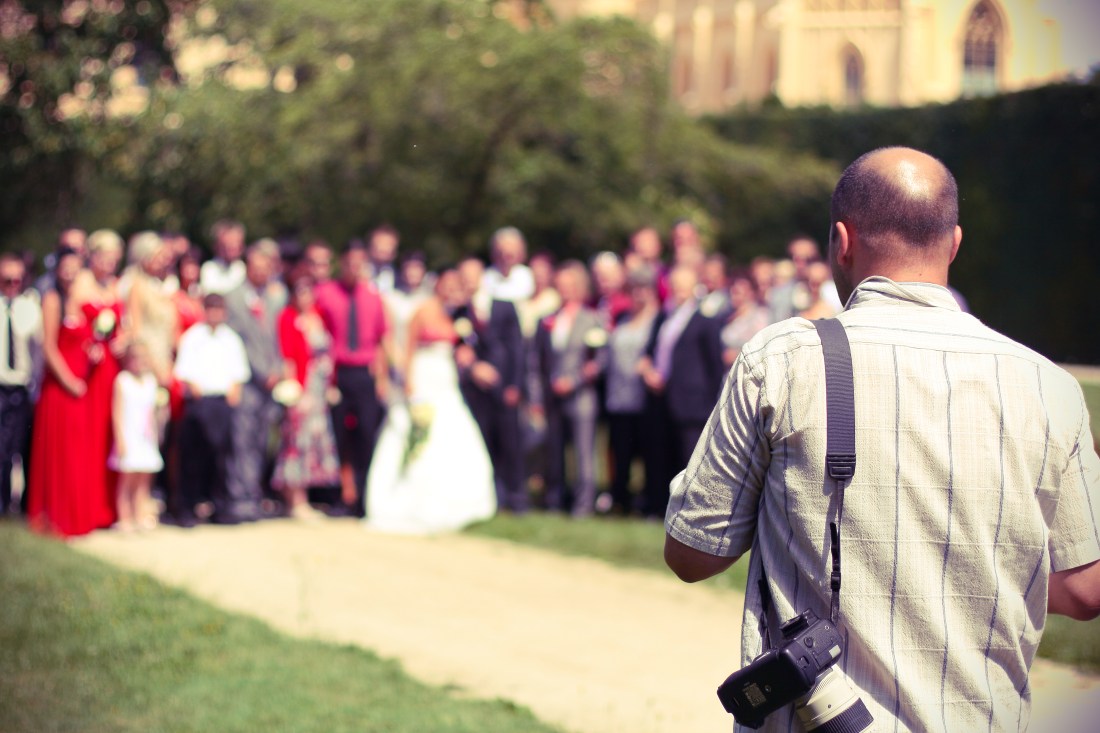
And we’d wait, sipping on a watery coffee, too understanding, too decent, and too annoyed to complain, until they exchange the rings, cut the cake, and call us for photos and gifts. We’d get in line after the bunch of squeaky young girls who spread whiffs of sweat and perfume as they flip their curls in my face. And when it’s our turn to wish the happy couple, I, along with the rest of the team, pull on a big fat smile on my face as if there’s no where else I’d rather be. We’d then pose for a group photo and a video clip for the couple’s photographer, and then someone in the team would pull out their iPhone demanding a groupie—as they call it now. First a front-facing, everyone-pouting photo for Facebook, and then a say-cheese Boomerang for Instagram, and at last a decent photo for the office WhatsApp group.

And I, since I’m not an absolute kill joy, would smile and go along. And at last, the photo session would end, we’d exit the stage so that the next group of friends can repeat the same process, and we’d head out in search of food, hoping it’d be worth the price of the cab and the gift.

Pray, tell me, am I missing the point?

When death rattles the gate

When I hear that someone died, my first thought always is, “Well, that’s what people do.” I don’t mean to sound cocky but even though I haven’t lost too many people close to me to the unavoidable oblivion, I’m conditioned to death and destruction. Every day, I walk to work on the perilous national highway. I’d witness an accident or what remains of an accident at least once a week. Many a Monday morning, I’ve walked over streaks of dried blood and stepped over shattered glass. Perhaps that’s why I’ve become a little hard on the inside, and cold about reacting to news of death.

However, when I heard a colleague passed away yesterday, I realised that even I’m not all parched on the inside.

He wasn’t a friend, and so we seldom conversed. Though we sat in close proximity to one another, we didn’t work on the same projects, and so both os us were happy not forcing small talk.

But I knew him and he knew me.

He’d spend his day making phone calls to customers while I spend my day hunched over my keyboard writing to customers. Our work lives pivoted on the same matters, even though our paths never crossed.

Sometimes, when he’d pick up a call, I’d pick up my headphones because I wouldn’t want to get distracted by his whimsical narratives to people halfway across the world. Despite that though, I’ve observed him.

I know his routine: He reaches the office at 10 but comes to his place at around 10.15 clutching a cup of coffee, he skips breakfast and grabs an early lunch so that he wouldn’t miss much of his shift time, and as the clock strikes eight in the evening he gathers his things ready to leave. He’d then commute an hour to reach home.

I know all of this because I’ve seen him at it—every day for months together. I’ve had no reason to strike up a conversation, but he was an active part of my routine, too. Perhaps that’s why I went blank when I heard he was dying. I couldn’t think, I couldn’t work, I couldn’t write to customers without him nearby, chatting with customers.

I’m not grieving his loss — why would I grieve someone I didn’t even know? And yet, ever since I heard the news, abstracts of his conversations with others keep ringing in my ear. He hated artificial sugar — he once explained to new recruits in our team that they shouldn’t ever add sugar to their coffee. He vouched for natural sweetness, mocking those who claimed refined sugar is, indeed, refined. And I’ve seen him smile and decline when people offered chocolate—and yet, he’d always bring candy for his friends from his trips abroad.

Sitting at my desk, I wondered why my mind wouldn’t drift away from this man I knew so well, yet knew nothing about. Memories flooded one after the other as I thought of a distant afternoon when we sat in a meeting proofreading a slide show presentation for a common friend. We both discussed — debated — the use of American spelling over the more rightful British spelling. We both preferred the British version, but when I suggested we use American, which is more familiar to our audience, he shrugged in a casual way. He just couldn’t accept “z” in the stead of “s”.

It’s the little things that linger the longest. I didn’t have to talk to him for hours over a coffee to understand his tastes, I didn’t have to spend time and money outside of work to get to know him. I can still picture his almost-always black shirt, his swaying walk and the skip in his step, the whisper of a song on his lips. I didn’t have to be his friend for his death to impact me.

For me he was one of five-thousand colleagues, one of fifty team members, one of twenty cubicle mates. People die all the time; he’s no different. Except that this time, I felt it a little closer than I had expected.

A birthday at work

“Hey Jared,” called out the new intern. She was much younger than I, but our work etiquette encouraged us to collaborate on first-name basis. I didn’t care much, because it made me, even only just, feel a little younger.

“Yes, Sharon?” I replied without looking up from my laptop. I had a project I had to submit by the end of the day, and I had just begun to put it together. It had been a hectic week, and I was already looking forward to the close of the day and the week.

Sharon didn’t reply. I typed away unpertubed for a while, but she called out again, louder this time, forcing me to look up, irritation balooning within me but a smile spreading on my fake face. “Sorry, was busy.” I added an extra emphasis on the last word. “What’s up?”

What an easy phrase that was—what’s up. So helpful when you don’t know what to say, yet so casual that it won’t sound like you’re pissed off at the person you’re saying it to—even if you are pissed off.

“It’s Wendy’s birthday on Monday, and we wanted to get her a cake, and also decorate her work place.”

Wonderful. Just what we needed now, a birthday party. As if we don’t have enough distractions already.

“Oh.” I replied, instead, unable to say anything further. As she looked at me expecting I’d say more, I forced myself to do so, “Oh, ok. That sounds cool.”

No it doesn’t. You’ve worked here one week, why would you throw Wendy a party when you don’t even know her that well?

“Great!” Her eyes popped with with excitement. We’ll order a cake and hang back after work today to decorate her place. You’ll help us, won’t you?”

Why should I? It’s Friday!

“Oh ok,” I trailed away. If I had to spend time decorating with the new kids in, then I’d better finish my work fast. I heaved a deep sigh. Just then, my phone lit up with a push note from my bank: my credit card bill had arrived, and I owed more than I could afford this month. Ah, well. More dues; no news.

I continued to type away wishing this project would end, and with it my responsibility in it. It had taken us more than half a year to get the project up and running, and even afterward, our clients came back reporting issues and disappointmnet. The boss and I had been emailing each other for a while now, he trying to get me to fix it, and I trying to explain to him that we don’t have enough resources.

“Hey Jared!” Sharon’s voice jutted into my thoughts again. Masking my frustration, I looked up again, and trying to sound as innocent as I could replied, “Hmm?”

She looked down at the notebook in her hand, biting the end of her pencil. “It’s three dollars each for the cake, two for the decorations, and a five more for the Papier-mâché doll—the present.” She narrated in an even voice, careful not to give away the impression of robbing me. I saw right through it.

Brilliant. Ten dollars down the drain. For a birthday that will only depress Wendy because she’s getting old.

Wendy and I had been colleagues for over two years now, and though she loved the occasional splurge, I knew she wasn’t taking this birthday in her stride. She had complained to me on various occasions about feeling “old timey”.

“Woah, that’s a handful.” I had to protest. These kids would do anything to get a few likes on Instagram and Facebook. After all, they still lived under their parents’ patronage. “Are you sure you want to spend that much?”

It’s almost the end of the month, and I’m running short of cash.

But I couldn’t tell them that.

“Well…” She dragged on trying to figure out a way to convince me. “It is a bit fancy, but it’s Wendy.” She cocked her head to one side, letting a little streak of untied hair fall down to her eyes. She pushed it aside in a sweeping motion. “She’s like a mentor to us,” she turned to the other four new interns who nodded as if their life depended on it, “and we want to thank her.”

Oh, well. Wendy will be happy, but I’ll be the one getting her a cab home from the bar tonight, after she weep-drinks complianing about her age.

I knew better than to judge Wendy. I had been there myself, and she had been there for me.

“Oh, alright then. Let me finish this first, and I’ll pay you after.”

If the kids wanted to thank her, but end up depressing her inspite of it, I’ll be there for Wendy.

And with that, I went back to my email, writing to the boss: “Sure, thing, Daniel. I can pull some strings with the supplier, and see how we can solve our client’s issues. You can count on me.”

Manipulator

“‘Mazing!” the boss appreciated. “This is such a great piece, Stan. I might give you a raise right away.”

Stan looked up. He hadn’t had a raise in two years because of ‘unfavourable economic conditions’. “Now?” His heart swelled, but the boss just smiled, and lifting his belly, waddled out the room.

Stan’s interns sat next to him. “It’s going to be okay,” assured Mark, a rich kid whose parents had “purchased” his internship.

“Well,” The boss had returned. “Wrap up that maze of an agreement. It’s brilliant—so binding that people wouldn’t know what hit them. Jackpot!” He exclaimed.