Decoding culture

One of the most prominent aspects of an Indian society is its lack of sociableness. Not that Indians aren’t approachable or jovial. On the contrary, Indians are some of the most hospitable folks in the world—but for someone travelling to India for the first time, our society throws more than a few culture shocks.

When walking on the streets, for instance, people never smile or acknowledge an unfamiliar face. They won’t maintain eye contact for more than three seconds, in fear of the other person misunderstanding. Most people I’ve come across on the streets, look straight ahead and then down as if focussed on avoiding potholes.

It’s not the fear of conflict that makes people avoid expressing themselves. Instead, it’s a habit that stems from childhood, when we learn to avoid speaking to strangers and accepting candy from them. We grow up with the same stigma, so much so that we don’t differentiate potential threats from unassuming people trying to be pleasant.

Most people you’d come across on the streets don’t see the point of smiling at someone they’ve never met before and will never again. When it makes no sense to grin at a wall, why should it make sense to grin at someone who’s as insignificant in their life as that wall?

That’s the reasoning I dabbled in for over twenty years before I landed in the United States. Where tables turned.

I walked into a restaurant, and the staff welcomed me with a gigantic smile and wide open arms. It was the first time we’d met and without a second thought, she made me feel as if I’d known her all my life. I didn’t even ask for her name, but we’re friends by recognition.

It’s her job to be social, a little voice in my head nagged. Not everyone would be the same.

Jet-lagged one morning, I awoke early for a walk around the neighbourhood I stayed at. It was a cold September morning and artificial pumpkins hung from behind locked stores. A single person lumbered on in the distance. When I got closer, I realised he was the garbage collector reporting on time for his duty. He smiled and waved at me for no reason. Without even knowing it, I was reciprocating his gestures. I didn’t think, and I didn’t debate with myself as to why I should wave. It was just nice, two people from such different backgrounds, with nothing in common, sharing a moment of warmth, each wrapped up in their own jackets trying to stay warm.

It’s not his job to be social, I realised. It wouldn’t have offended me at all if he’d had ignored me altogether. I would’ve gone my way and he would have gone his, both of us bracing the cold. Instead, we did go our own ways but with a cheery stride. And that made all the difference.

Later as I sat in the shuttle, a complimentary service my hotel offered, my driver—an employee of the hotel—asked me how I was. She didn’t have to. It was a ten-minute ride from my hotel to my workplace, but she took that time to share a conversation. We didn’t discuss global economy, but we did talk about how difficult it is to find employment nowadays. I left the shuttle a little wiser to the reality of the world, and I felt myself balloon with compassion and sincere respect for my driver. We weren’t venting to a stranger, but instead, we were riders in the same boat, sharing observations.

Throughout my stay in the US, I met with countless people who volunteered to make my day better. With a smile, a wave, a head bob, and even a small nod in the right direction, strangers all around me made me feel at home.

Perhaps it’s all because I was a tourist, my skeptical inner voice piped. No, I answered as I explored the streets further. More about that later.


Medical terms

“Well, the severity of chemotherapy varies from person to person. For some its a seven-course treatment, and for some, it’s just one. And who’s to say, sometimes neither survives longer than a few months. In any case, Mom, it’s difficult to generalise the effects of chemo.”

As Dr. Castro spoke, his mother cast him a look of love and distain. Candid though he was about his own disease, his impassiveness pained her.

Driving away, Dr. Castro let a single tear fall from behind the mask he’d worn all day. After all, he’d never see his daughter dress up for prom.

Deserving

The Masons never hurt a soul. With abundant wealth, the childless couple donated to countless charities every year. They were good people.

They didn’t deserve a stillborn.

The doctor held the unmoving child, as he extended trembling arms. His wife slept, peaceful and unaware. The never-existed ghost of a smile played on his daughter’s face. Time froze. What would he say when his wife asked? He’d promised her all would be well. He’d assured her. He was to blame.

As his tear dropped on its cheek, the baby stirred. Before he could comprehend, his Hope blinked and began to cry.

Under unnatural circumstances

A self-professed nature lover, I adore wild trees with their branches untamed, flowers scattered about, and squirrel-bitten fruits ripening in various stages. Something about unpruned nature gets me excited every time I see it. Whenever I see manicured plants in the various housing apartments in my locality, I cringe and pass silent judgement at those who resort to a vain attempt at getting close to nature.

Regardless of my disdain, however, I realised that I appreciated the same practice when I saw it in the US. Not because it’s a foreign country and that I wouldn’t say anything against such a global leader—no. A dissenter, I can vent about the country at length. But that’s not for now. But the real reason I enjoyed organised nature in the US is because for the first time, I saw it done in style and in clear consideration. It was in Dublin, a small locality in the Pleasanton area of California.

Hacienda Drive, Dublin

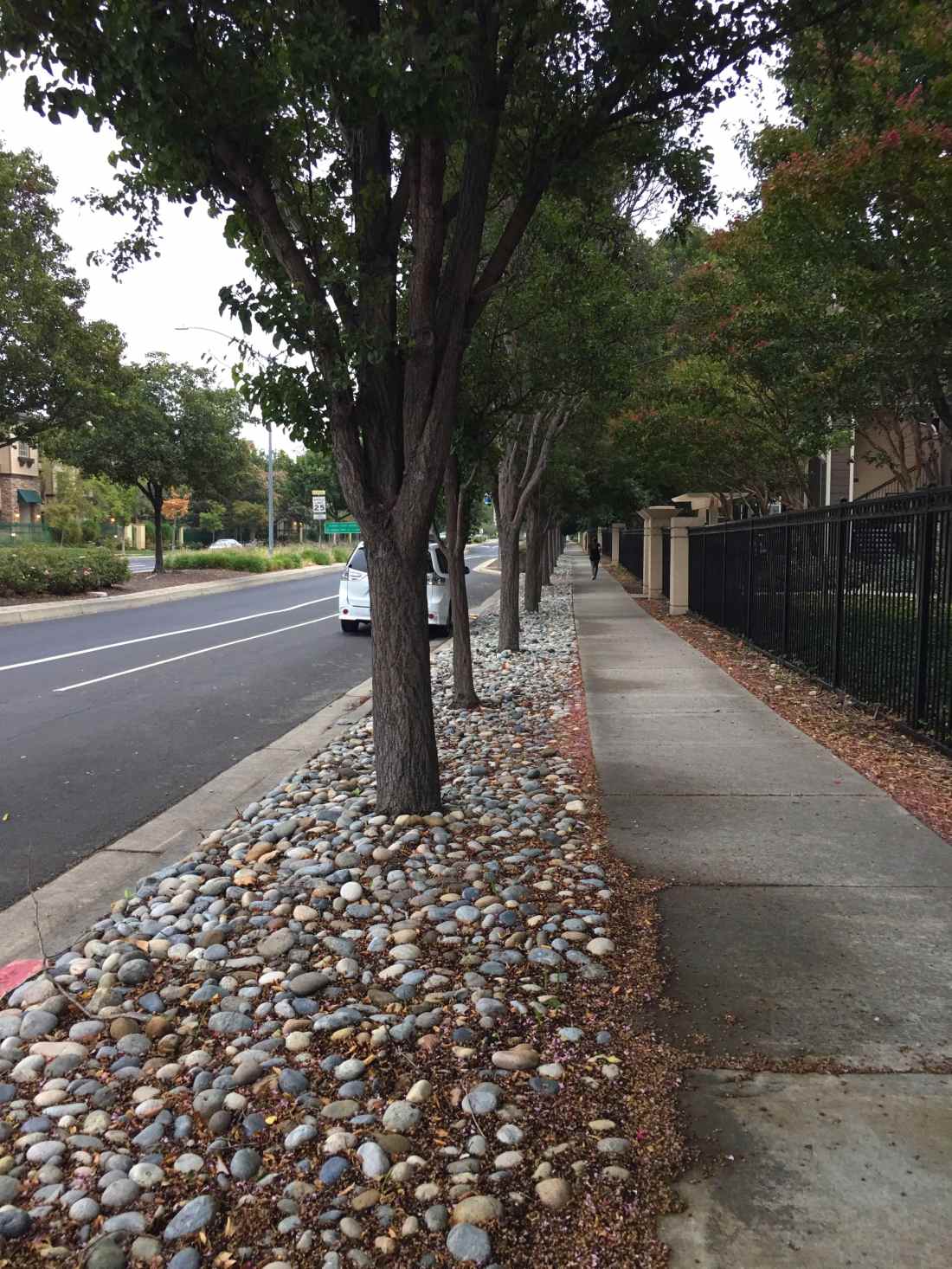
The first thing that struck me about Dublin and the rest of Pleasanton is how clean the place is. I’d seen far shabbier localities in San Francisco city, so I knew Pleasanton did something different. It was when my colleague mentioned that Pleasanton is a planned city, that it dawned on me what an artificial place I was at.

Nothing about Pleasanton seemed natural. I began to notice the little things that came from elsewhere, planted and pieced together to form the city. From the trees that lined the footpaths to the pebbles that added beauty and glint, not a twig was out of its place. Shrubberies grew well within their borders, leaves stuck to their branches, and all fruits at the same stage of ripeness.

Pathways, Dublin

Regardless of all that, I still enjoyed walking around the neighbourhood. I didn’t know why at first, but the more I explored, the more I understood. Dublin is a rich neighbourhood. Most of its population has passed middle age and is considering settling down and retirement plans. Since a lot others are either business owners or high-level corporate employees, they don’t need to haggle to get through each day. They, unlike people in unplanned cities, can afford to demand perfection. They’re so accustomed to having things their way that improperness gets on their nerves. The whole town, for instance, shuts off at about 9:30 pm. Nightlife is almost non-existent in the streets and silence rings louder than a foghorn.

Houses in Dublin

All of this was new for me. I’d never before shared privileges that the Dublin folk takes for granted. And that’s why the perfection and drastic change of scenery impressed me. Walking by house after house, each competing with the other in terms of class and bigness, I gawked in surprise. Walkways were seamless, street signals on time, traffic rare, and drivers polite. While I admired in wonder at everything I saw, it was as if nothing could surprise the locals. They’re used to everything being the way it is—designed without a single flaw.

Did I cherish my time in Pleasanton? Of course, I did. I felt elite and rich. Although I don’t see myself living in such an environment (until perhaps I’m 60 and cranky about petty things) it was wonderful nevertheless.

Dublin trees

Oh, and though authorities count and account for each tree, the sunlight glittering through them is a sight worth beyond words.