The Bearded Bard

The best thing about the Bard: he makes you think. He fills you with wonder, shows possibilities you hadn’t considered, and leaves you in a flurry of amazement.
bard

Shakespeare’s command over the language stuns me. How could one man possess such understanding of the language we hold dear?

Words are sharp, they are powerful. They inspire all kinds of emotions. The good, the bad – they’re all in words. Even those deep feelings we can’t put into words  —  Shakespeare has his way of bringing them to our mind’s eye.

He makes you feel the word. Is it the wording, or a full stop in place of the overused exclamation mark? A little use of the license, or a negligible grammar violation that makes a tasteful piece of writing?

No one does it as well as the Bearded Bard.

If words be actions, Shakespeare can make you cringe in shame, in such a way that you relive that moment each time you face a mirror. All these, without laying a finger on you.

The sheer thought of such power scares me.

Everything the man ever wrote is wisdom for a society that’s as foolish and as ignorant as ours. There never will come another writer whose works live as long as Shakespeare’s. Five centuries old; still as attractive, as delectable as fresh pie.

Though he largely referred to the Elizabethan society, his works seem tailored for us.

That makes me wonder  —  why do we have such a society? A society that holds self before anything else, one that judges people on birth, instead of the person they’ve become.

Why are we such Assholes?

It’s all in the marriage of two minds.

Let me not to the marriage of true minds
Admit impediments. Love is not love
Which alters when it alteration finds,
Or bends with the remover to remove.
O no! it is an ever-fixed mark
That looks on tempests and is never shaken;
It is the star to every wand’ring bark,
Whose worth’s unknown, although his height be taken.
Love’s not Time’s fool, though rosy lips and cheeks
Within his bending sickle’s compass come;
Love alters not with his brief hours and weeks,
But bears it out even to the edge of doom.
If this be error and upon me prov’d,
I never writ, nor no man ever lov’d.

We are a society that prioritizes the need for a partner. For everything. It begins at school when we look for a lunch buddy, visit the restrooms in pairs, or hang out in groups.

Solitude is taboo. We grow up to that principle. We are so accustomed to the warmth of human companionship that we reach a point where the quality doesn’t matter as much.

We’re happy as long as we have a partner. Perhaps that’s what forces us to rush into relationships, both marital and otherwise.

Perhaps we don’t dedicate thought to the person we commit to spending our time with. Because when we do, we realize the subtleties and positives of the relationship.

If only people’s minds were married instead of the bodies, we would have a whole different populace.

Our attitude toward life would differ. It would be a full, retrospective thought process, where we’d have worthy priorities.

People would marry for true love, they would sacrifice, and do so, knowing the consequences. And everything we do would have clarity. Our society would sincerely respect each other.

Or as the great man says himself, we’d know from experience,

“Love is not love … which alters when it alteration finds,”

Once we realize the truth in those words, nothing would be greater than true love. Love that spreads warmth and compassion across the world.

And that would be a world worth protecting.
What do you eat?

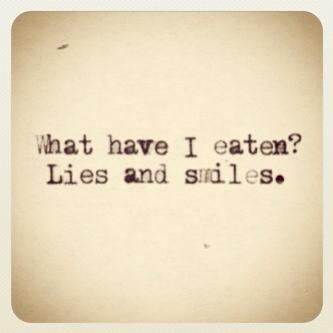
Sylvia Plath is beginning to grow on me. Her words are hauntingly relatable. They have an aura of dark reality that simply refuses to leave the mind. This one here is no different.

Sylvia Plath - what have I eaten

It’s bitter, it’s harsh, and it’s the truth.

Lies and smiles – that’s all we’ve consumed all our lives. Just thinking about it makes me wonder why it never before occurred to me. It’s the simplicity of the fact that makes you want to slap yourself hard in the face.

What a two-faced world we live in! Each of us has a face unknown to the rest of the world. A face that lies, a face that smiles; it’s become impossible to discern one from the other.

We’re all mere players in a world that’s as mysterious as we are.

P.S – Image source: Pinterest

The Bard turns 450

Image credit: Creative Commons

Last year, same date, I shared a poem, by the bearded Bard himself. It’s his 450th birthday today, and everywhere, people are surely celebrating him on their blogs and other social media.

One of Shakespeare’s greatest and my favourite play, is Macbeth. I don’t really know why, but, I know I like tragedies. And Macbeth is one of the biggest tragedies. Here, is the infamous scene of Macbeth, also the major twist in the plot.

Enjoy.

Act 1 Scene 3

MACBETH:
So foul and fair a day I have not seen.

BANQUO :
How far is’t call’d to Forres? What are these
So wither’d and so wild in their attire,
That look not like the inhabitants o’ the earth,
And yet are on’t? Live you? or are you aught
That man may question? You seem to understand me,
By each at once her chappy finger laying
Upon her skinny lips: you should be women,
And yet your beards forbid me to interpret
That you are so.

MACBETH: 
Speak, if you can: what are you?

First Witch: 
All hail, Macbeth! hail to thee, thane of Glamis!

Second Witch: 
All hail, Macbeth, hail to thee, thane of Cawdor!

Third Witch: 
All hail, Macbeth, thou shalt be king hereafter!

BANQUO: 
Good sir, why do you start; and seem to fear
Things that do sound so fair? I’ the name of truth,
Are ye fantastical, or that indeed
Which outwardly ye show? My noble partner
You greet with present grace and great prediction
Of noble having and of royal hope,
That he seems rapt withal: to me you speak not.
If you can look into the seeds of time,
And say which grain will grow and which will not,
Speak then to me, who neither beg nor fear
Your favours nor your hate.

First Witch: 
Hail!

Second Witch:
 Hail!

Third Witch: 
Hail!

First Witch: 
Lesser than Macbeth, and greater.

Second Witch: 
Not so happy, yet much happier.

Third Witch:
Thou shalt get kings, though thou be none:
So all hail, Macbeth and Banquo!

First Witch: 
Banquo and Macbeth, all hail!

MACBETH:
Stay, you imperfect speakers, tell me more:
By Sinel’s death I know I am thane of Glamis;
But how of Cawdor? the thane of Cawdor lives,
A prosperous gentleman; and to be king
Stands not within the prospect of belief,
No more than to be Cawdor. Say from whence
You owe this strange intelligence? or why
Upon this blasted heath you stop our way
With such prophetic greeting? Speak, I charge you.

-Witches vanish-


Want more? Read the full play here.

All the world’s a stage

Copy of seven ages of man

All the world’s a stage,
And all the men and women merely players:
They have their exits and their entrances;
And one man in his time plays many parts,
His acts being seven ages. At first, the infant,
Mewling and puking in the nurse’s arms.
And then the whining school-boy, with his satchel
And shining morning face, creeping like snail
Unwillingly to school. And then the lover,
Sighing like furnace, with a woeful ballad
Made to his mistress’ eyebrow. Then a soldier,
Full of strange oaths and bearded like the pard,
Jealous in honour, sudden and quick in quarrel,
Seeking the bubble reputation
Even in the cannon’s mouth. And then the justice,
In fair round belly with good capon lined,
With eyes severe and beard of formal cut,
Full of wise saws and modern instances;
And so he plays his part. The sixth age shifts
Into the lean and slipper’d pantaloon,
With spectacles on nose and pouch on side,
His youthful hose, well saved, a world too wide
For his shrunk shank; and his big manly voice,
Turning again toward childish treble, pipes
And whistles in his sound. Last scene of all,
That ends this strange eventful history,
Is second childishness and mere oblivion,
Sans teeth, sans eyes, sans taste, sans everything.

— Jaques (Act II, Scene VII, lines 139-166)

The seven ages of man, as told by the man who celebrates yet another birthday today.

Alright, he’s done that for years now and will do so in future as well. That’s not the matter. No. I am not going to write another blissful blog post about how Shakespeare influenced the language and literature that we hold dear. That’d be a crappy and boring read; too many people would be doing it. Having read that excellent speech recorded in the pages of literature, I’d be surprised if you are even reading this. That’s the point. Shakespeare’s words need neither prologue nor epilogue. Thus, I wind up.