Creator

Wielding her weapon, Margaret felt immense power surge through her veins. Everything rested on her — she could make or break Larry. She could poke, tease, torture him even, and no one to intervene.

She could control him, discipline him, and boss him. Like a puppeteer she could play with his arms and legs, like a sore partner she could mess with his soul, like a disowning parent she could stare until he withered in shame.

She had created him, and she had every right to destroy him. After all, she wouldn’t be the first author to torment her characters.

Young copywriter

young copywriter

She had always been a nobody—getting coffee for managers, delivering posters from office to office, trotting after leaders, taking notes as they dictated and sipped the coffee she had brought.

Everything had paid off, she realised, caressing her desk. Copywriter — at last, a real job with real purpose.

She read volumes of how-to and best practices. But when she had to write on her own, she stumbled. It was one thing to read through inspirational ad copies and gawk at others’ eureka moments, but a tougher task to write herself.

“Why don’t you get some coffee?” A colleague suggested.

Morning’s here

My alarm goes off as it always does, and I wake up to my well-crafted routine: yet another week of working all day and reading through the night.

I’m awake tireless as the fresh morning oxygen spreads through the room, seeping through me, soaking me from within, waking the rest of the deep-sleeping cells in my brain.

Though it’s only five AM when I look through my mosquito-proofed window, I see that the navy sky has already lost most of its depth, while lighter hues of blue appear in batches like patches on rough skin. Day breaks early, the long-lingering aftermath of a dry and scorching summer; a May that followed months of rainless skies.

Somewhere far away, a lone young cuckoo calls, jerking the others in the family awake. They all call to each other greeting the rising day, as I turn away—it’s time for my workout.

A few burps, some burpees and lunges later, I put a pot on the stove and cast my window’s curtains aside. Turquoise has replaced the navy and white streaks meld with the blue as the morning prepares to wake the sleeping sun. Grabbing my tea, I sit facing my window, looking through the checkered mosquito-net, looking beyond at the now cloud-filled sky.

I look closer, harder, squinting my eye at the unblemished white blanket that hangs over my roof, trying to catch a glimpse, a peek, at the waning crescent of a moon while she waits in stillness for the gliding clouds to gobble her remains. As she goes by, a gentle breeze wafts through the bars of my window, bringing with it, scent of warming wet sand and photosynthesising begonias from the neighbour’s balcony. It tricles my ears, whispering morning hope as I close my eye lids to embrace it. It kisses my eyelashes, teasing me to fall back, to grab a pillow pressing my face against its cool surface.

Breathing in deep, I open my eyes. For to fall back asleep would be to waste away the glory of day rise I had experienced. I drown my tea and reach for my towel. Turning away from the window where the sun steps out from under his covers, I head for a shower, a rhythm in my head.

Ah, June, how I adore thee.

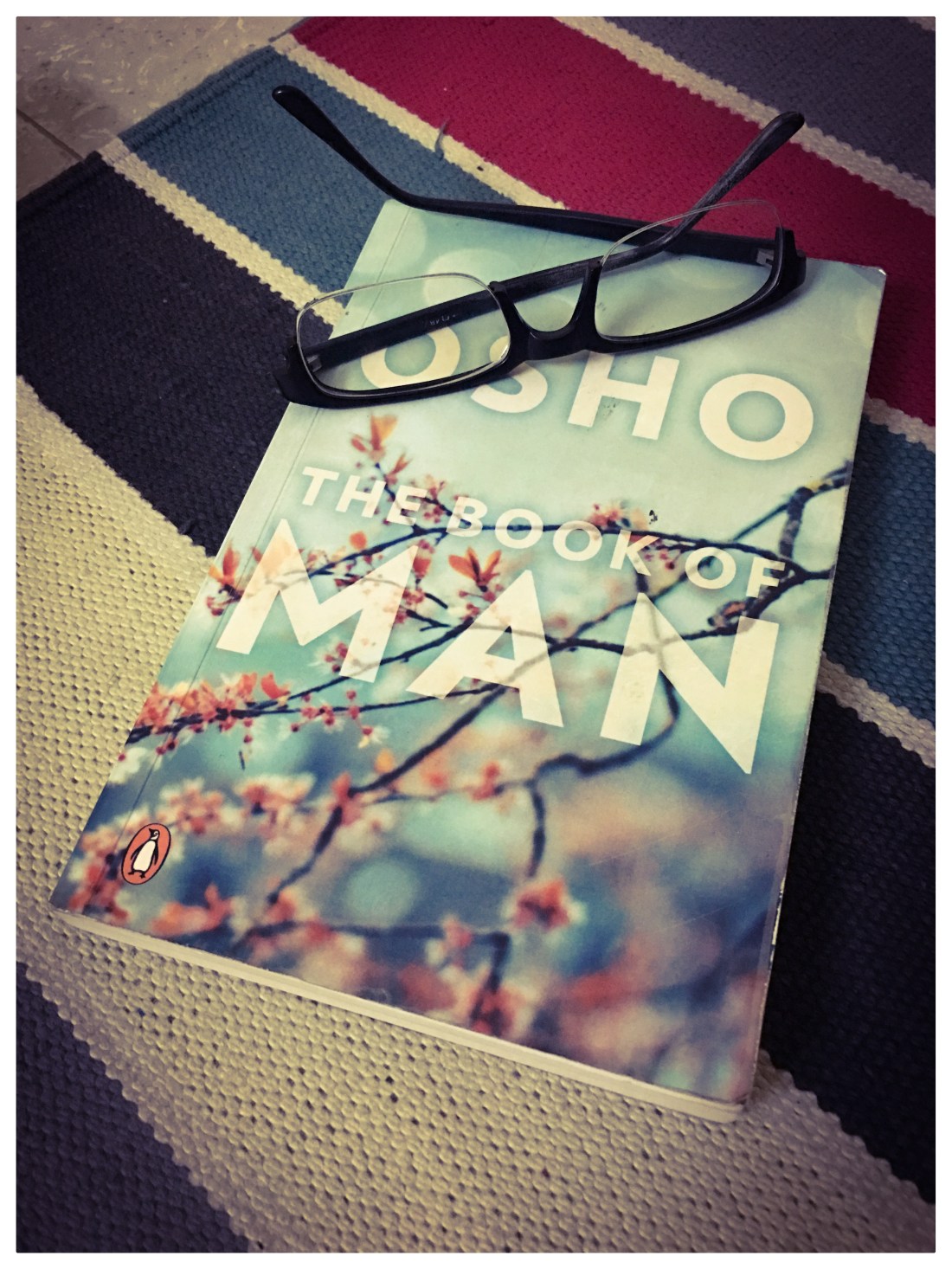
Osho’s Book of Man

I never imagined I’d find a book that I liked and disliked in equal measure. But then I read “The Book of Man” by Osho. He’s a famous Indian godman, and until a few moments ago, I didn’t know he was also a dead man.

I had read quotes of Osho before, and so the idea of reading a book meant for men excited me. But I also wondered how preachy the book would be. I knew that Osho was a Zen master and his disciples were abundant, so I was a little apprehensive I’d find something on the lines of the “do this in life and you’ll have everything you need” dogma.

The first thing that stood out to me in the book is its Contents page. Before I read any book, I go through the chapter names. I try to extract the essence of a book just by looking at the way the writer names their chapters. In this book, Osho addresses various issues from a man’s perspective; from facing the mother to serving the wife, from marital affairs to soulful meditation — every chapter is a name of the various roles a man has in life. Some of the names are, The Zorba, The Macho, The Playboy, The Politician… you get the idea.

It’s a lot similar Shakespeare’s “Seven Ages of Man” except Osho takes a more detailed view of things. Just the few pages amazed me. Simple narrative, great advice, amusing anecdotes brimmed throughout. It was an easy read, also because of its good print and fine paper. And even though I wasn’t the “intended” audience, I enjoyed the book nevertheless.

Reading through these chapters, I realised not just the truth in Osho’s words but also that I agreed with his points of view. To me they seemed obvious, something I already knew deep within my mind. And it made it all the enjoyable to turn page after page.

For example, the idea of raising a child terrifies me. Children are perceptive, they observe so much and learn all they know from what they see and hear. One wrong move by the parent and a child has a wrong idea rooted in its mind for life. And that’s why I try to stay away from kids, even when colleagues bring their kids to work. What if I’m having a bad day, and blurt out something I the kid shouldn’t hear? Of course, it could be just me being me. Not many of my friends think the same way — they love kids, they play with kids, and they never over think it as much as I do. That’s why I almost yelled out in agreement when I read passages like this:

“Children are very vulnerable because they are born as a tabula rasa — nothing is written on them, their minds are pure. You can write anything you want on the child.”

To me, Osho said all the right things, and my first impression of the book and the man soared through the skies.

Commenting about fasting, he says that there’s no point in it. He goes on to say how the world reeks in poverty and starving people while we have all the food and still fast — just for the attention it brings us. Here Osho picks on Mahatma Gandhi.

“Mahatma Ghandi had everything available to him, although he lived like a poor man. One of his intimate followers, a very intelligent woman, Sarojini Naidu — has a statement on record that to keep Mahatma Gandhi poor, they had to spend treasures on him. It was not simple poverty, it was a managed show. He would not drink milk from a buffalo because it is rich, rich in Vitamin A and other vitamins. He would not drink the milk of a cow because that too is rich, and poor people cannot afford it. He would drink only the milk of a goat because that is the cheapest animal and poor people can afford it. But you will be surprised; his goat was being washed twice a day with Lux toilet soap!”

Wikipedia says Osho was an outright critic of Gandhi so I understand the hatred. But this is a powerful moment; a lot of people revere Gandhi and try to live like he did. The writer has scattered the whole book with truths like this, truths that makes the reader cringe.

Excited, I read on. About sixty pages into the book, I stopped. Something had changed, and it was a change too jarring to ignore. His tone became more opinionated, losing sight of reason. Not a god-loving person, he attacks religion and social customs. I do it, too, so that’s not weird. But what was weird, though, is that he lashes out against Christianity and the holy trinity. And to make it a more distributed criticism, he names a few Hindu beliefs silly, too.

As he goes on, some of the claims become narrow and even absurd.

Speaking about homosexuality,

“Homosexuality is a necessary phase in the growth of a man or woman[…] So drop any attitude about homosexuality; that is nothing but the propaganda of the ages. Nothing is wrong in it, it is not a sin. And if you can accept it. And if you can accept it, then naturally you will grow out of it and you will start being interested in women, but you have to pass through it.”

That was painful speed-breaker moment. I read on, though, because I wanted to see where he went with these claims. Turns out, no where.

The quote had a disclaimer about Osho’s four stages of sexual growth: auto-sexuality in a child, homosexuality which precedes heterosexuality, and then the last phase of going beyond phase — brahmacharya.

By that time, I had lost interest in Osho. I had thought his observations were relatable, yet revolutionary in a way. But it turned out that I don’t have the maturity to accept all his teachings. My perspective had changed, and I grew disappointed.

In hindsight, I don’t regret reading the book. Well, there were moments I wished I hadn’t, but there were also moments I cherish. In short, this book sparked such conflicting emotions in me. I wouldn’t recommend this book to anyone, because most of it is too subjective. Also, the writing is almost terrible. As a reader, it turned me off. I began wondering why Osho made the same point in three different sentences. As a web copy writer, I twisted in my seat at the repetition in the book — it was far from thoughtful. If I had edited the manuscript, I would’ve cut out at least 70–80 pages.

Oh, and Osho also wrote a book for women, titled The Book of Woman. And yes, of course, it’s pink.

What is a book to me?

When reading a novel, a short story, or a work of non-fiction, I don’t think about anything other than the story that the words in front of me tell me. I don’t care how the writer felt when they conceived the idea, how they strove to string words with words, how inviting the couch seemed when they had work to do. I don’t think about the trauma, the self-doubt, or the fleeting convictions a writer endures before they even get through the first paragraph of what they’ve imagined as a five hundred-page New York Times bestseller.

Holding a book, caressing the hardcover, flipping over to read the blurb, I’ve never even spared a thought about how a writer looks at their book. Published writers, I found out, have varied perspectives about their books. For some it’s a task — a taxing, yet compulsory process they need to endure to hear themselves speak their minds. For some others, like Anne Bradstreet, it’s like giving birth. I came across her poem where she says what it means to her to write and sell a book.

Thou ill-formed offspring of my feeble brain,

It took me a while to understand the depth of her emotions, to appreciate her attitude. She extends the metaphor throughout the poem, addressing her book as a mother addressing her child. She apologises for her maternal instincts, for fussing over her child, for washing its face to make it presentable—for being a mother like any other.

I washed thy face, but more defects I saw,

And rubbing off a spot still made a flaw.

I stretched thy joints to make thee even feet,

Yet still thou run’st more hobbling than is meet;

I had always imagined, if I ever published one, that I’d be happy to put my book out, to let the world see and drop its jaws in awe. But Anne Bradstreet has a different view. She’s sad that she can’t afford a better overcoat for it, she doesn’t want to cast it away and force it to fend for itself. She wants her brainchild to live in grandeur and splendour—all the things a mother wishes for her child.

In better dress to trim thee was my mind,

But nought save homespun cloth i’ th’ house I find.

She’s helpless, a mother struggling to make ends meet, dabbling in poverty, hurting because she’s unable to supply for her child. However, though hesitant, she lets go in the end — because she has to. At last she accepts reality, gives in because the only way for her to live is to send her child out the door.

This is a wonderful poem to read again and again. Here’s the whole of it, if you’re interested.

The Author to Her Book – Anne Bradstreet

Thou ill-formed offspring of my feeble brain,
Who after birth didst by my side remain,
Till snatched from thence by friends, less wise than true,
Who thee abroad, exposed to public view,
Made thee in rags, halting to th’ press to trudge,
Where errors were not lessened (all may judge).
At thy return my blushing was not small,
My rambling brat (in print) should mother call,
I cast thee by as one unfit for light,
The visage was so irksome in my sight;
Yet being mine own, at length affection would
Thy blemishes amend, if so I could.
I washed thy face, but more defects I saw,
And rubbing off a spot still made a flaw.
I stretched thy joints to make thee even feet,
Yet still thou run’st more hobbling than is meet;
In better dress to trim thee was my mind,
But nought save homespun cloth i’ th’ house I find.
In this array ‘mongst vulgars may’st thou roam.
In critic’s hands beware thou dost not come,
And take thy way where yet thou art not known;
If for thy father asked, say thou hadst none;
And for thy mother, she alas is poor,
Which caused her thus to send thee out of door.