The Witch of Portobello is one my favourite books of Paulo Coelho. But I’m not sure if I agree with him on this one.
I’m no extrovert. And I’m no expert.
But I do know a lot of extroverts. And I know they love making merry and being comfortable. But so do introverts. We all want to be happy. The difference is how we represent ourselves. If extroverts are happy in large gatherings of friends, introverts are happy in the company of one good friend. It’s just that not many people know it when introverts are happy, because we share it with a select few. As for our extrovert counterparts, they like sharing their happiness with more than a select few.
But on a deeper level, extroverts or introverts, we all try to prove something to ourselves. And if being happy is what it is, then I say, nothing’s better.
I just read Twice Born, a novel by Vijay Raghavan. After having read three books of Paulo Coelho’s, I needed a break. And so, I turned to some Indian writing.
I hate it that sometimes Indian writers try too hard. They try hard to sound as close as they can to a native English writer. Which is fine, except, none of the British and American writers I read seem to write books with a thesaurus in hand.
And when I read this book, I thought of Joey and big hearts.
Maybe it’s just me, with my measly vocabulary, but to me, if a writer can’t convey her thoughts in a simple way, she can’t convey her thoughts at all.
After all, I heard it was Einstein who preached that if you can’t explain it to a six year-old, you don’t know it yourself.
But I digress.
This is a story of an English professor, also the narrator. One fine day, he realizes he’s schizophrenic, and two characters pop out from his head to help in his “conquest of happiness.” A doctorate in English, he names these characters Dr Heckyll and Mr Jyde. Throughout the rest of the story, these characters talk to him, advise him–even insult him at times–and at last, lead him to answer his own questions.
Even for someone who hates having to open the dictionary every few paragraphs, I enjoyed this story more than I hoped to. Maybe it was the effect of too much Coelho, but the plot of Twice Born ran fast and captivating. It was a peek into the life of a man torn between the Indian and the Western world. The narrative was honest in most places, a little philosophical at times, but overall — detached. I didn’t feel emotions seeping out of any of the characters; they all seemed logical, straightforward and calculative.
Nevertheless, I had my moments with this book. Moments like this.
I’ve begun to lose interest in Paulo Coelho. And trust me, I don’t want to.
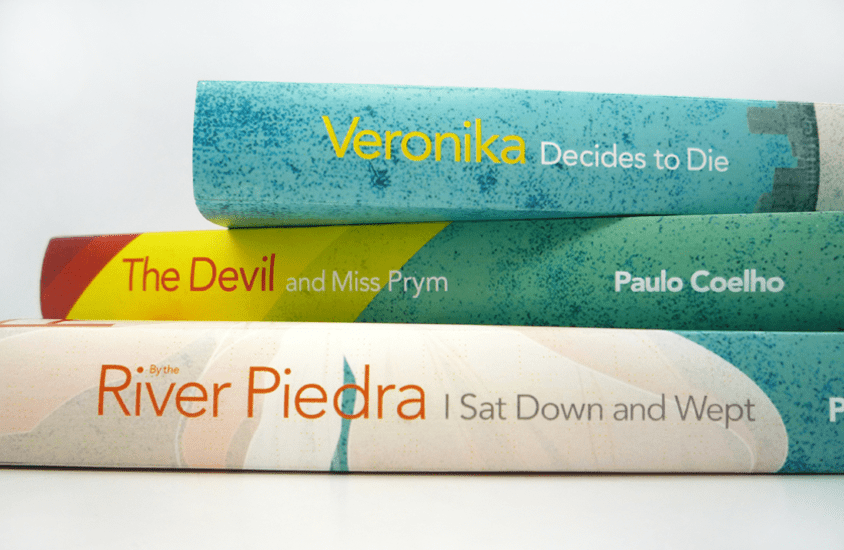
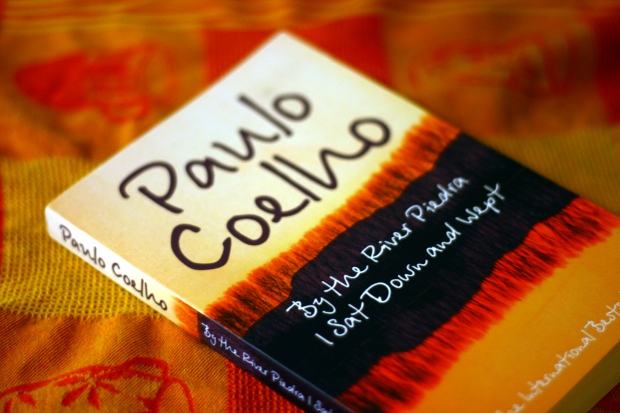
Every time I open one of his books, I look for that something I found in The Witch of Portobello. I loved that book, and in comparison, both books I read afterward (By the River Piedra I sat Down and Wept and The Devil and Miss Prym) ended up disappointing me.
The thing with The Devil and Miss Prym is that I got lost plenty of times while reading the book. I admit, I was sleep deprived, but even so, the book was a painful read. Plus, I had a bus journey of about 6 hours to look forward to, and the book was my sole companion.
I almost forced myself to finish reading this book. It’s one of those stupid things they call closure. Unless I finish reading a book, it keeps popping up in my head, bugging me, torturing me, and making me feel all kinds of guilty.
So I leaned back in my seat and, stifling my yawn to avoid my neighbour from judging me, opened the lovely-coloured cover. And every five minutes, I had to tear my eyes off the view of the street and get back into the book. That’s how slow it went.
But with all respect, the book wasn’t all a loser. It was nice, and parts of it were great. With a simple narrative, a solid story, and some good characterisation, it was a decent read.
It just wasn’t my type.
Perhaps it’s just me, but I’ve started to think Paulo Coelho is trying too hard to be philosophical and spiritual. All this talk about what’s right and what’s not, the co-existence of devils and angels, evil and good, the question of conscience, and the unmistakable victory of all things good — and here I am wondering what’s new. It’s the “same ol’ same ol’” story.
But I don’ want to give up yet. One, because I still hope Paulo Coelho had written something as captivating as Athena’s story. And two, because I had already bought a boxed set of his books that I don’t want to leave unread. Oh, and the covers — they’re beautiful with luring fresh print, and my mind seeks closure.
Part of me wants to give up on Paulo Coelho — at least for the time being, but the bigger part of me wants to read the other books too — just in case. I don’t want to miss a great book, just because I didn’t like a couple.
I’ve been having a bad last year, not finishing the books I started. So this time, I promised to get in a lot of reading as possible.
I had bought a boxed set of Paulo Coelho’s books, and after The Alchemist and The Witch of Portobello (which I loved), I opened this one with the same interest.
I was a bit disappointed. People had warned me about the author’s excessive reference to religion, but not having experienced it much in other books I had read, I went into this one innocent.
I won’t deny, there were some great parts where I could relate to the story and to the spiritual message. But by the time I finished the book, I was left only with the author’s strong religious beliefs. I even had the feeling he had tried to force his belief into the book.
Nevertheless, it was an easy read, and I liked the way the author differentiated the love for god and the love for people.
Overall, I’m not sure if I liked the book enough to recommend it to anyone. Would I read it again? I don’t think so.
I revere History as a subject. That’s also why I hate that it’s become so subjective. No one knows what the truth is anymore, we’re all so engrossed in stories that interest us so much that we often forget that the words “story” and “history” don’t even belong in the same sentence.
It hurt so bad when I came across in my text book that Queen Elizabeth the second took the throne in 1963 when the very next page claimed that it was in 1953. Though that is more of a valuation of our education system than History, it still put a thorn on my head.
That’s when it all came crashing down. We don’t care what happened all those years ago, we only care for what’s more sensational. The more interesting story goes into school books — to become history. The more interesting a story, the more it’s spoken about. And we all know the more we talk of something — especially in schools — the more the chances are of it becoming a fact.
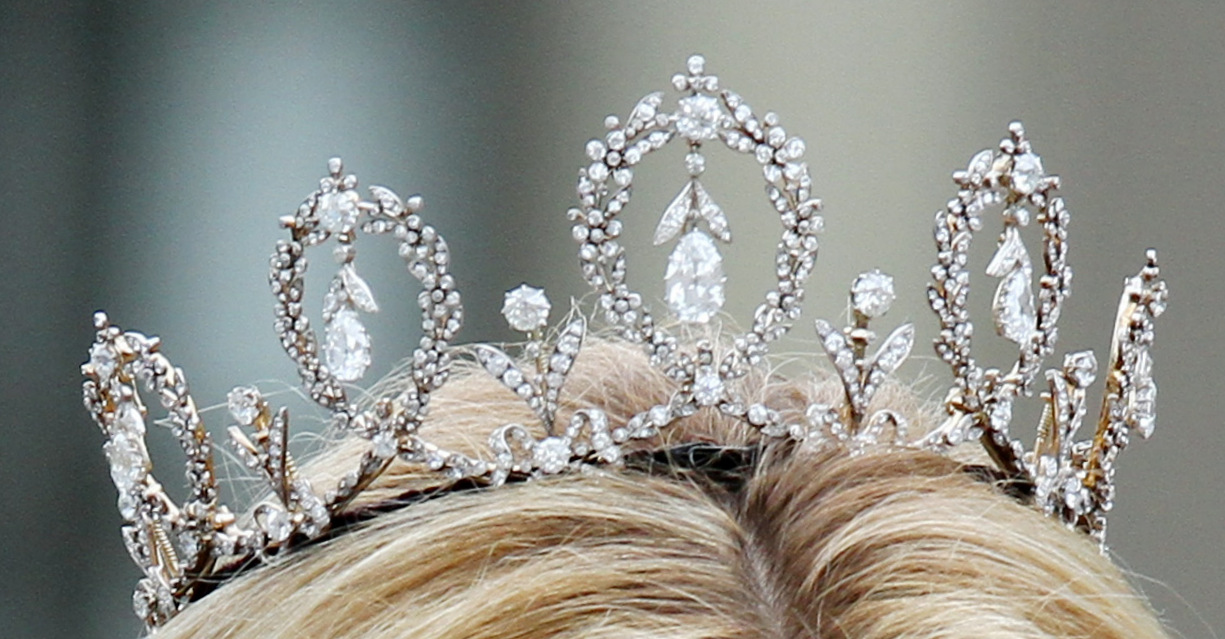
It’s quite sad that people are so used to telling and retelling facts as stories. Besides, how much of a difference would it make if the Queen wore a tiara instead of a crown; the tiara is the fancier word isn’t it?
What starts with a tiara grows on to elephant rides becoming horse rides, corn becoming cotton, and eventually Pakistan becoming India. It’s just a matter of time.
Is it the human craving for adrenaline that makes us morph the truth — or what’s commonly accepted as the truth — into something a bit more… racy?
What’s wrong with calling an execution an execution? Must we make it a chase and kill?
It’s all subjective; we’re are so used to talking about heroics and racing cars that we like to incorporate them in our narratives. The sad part of it all: we do it instinctively, we do it without care, we are so offhanded that in a way, we kill the essence of our History.
Sometimes, we just have to accept our forefathers for what they were — cowards. Sometimes we have to live with knowing they lived bad lives, and that they had priorities we deem unworthy. Because only when we accept history for what it is, can we learn and not duplicate the very lifestyles we mask with gossip.



 The Chaos Within