Hey, universe… A little help?

“And, when you want something, all the universe conspires in helping you to achieve it.”

Does it, though?

When I read The Alchemist years ago, this particular quote stood out to me more than any other. It wasn’t just me, everyone spoke about Paulo Coelho’s declaration that the universe accommodates the dreamer. It was aspirational, and it led me to believe in myself a little more than I did before.

That was years ago.

As I grew up and dreamt of bigger and more worthy goals, I realised that the universe was far from helping me. It started to seem as if the universe was going out of its way to prevent me from reaching my heart’s desire. Every task turned sour. Every day, and every want became painful to swallow. I started channelling my anger and frustration at Coelho for stuffing my head with false promises when none of his claims worked for me. Not that I failed in all of my endeavours, but the process of achieving them often seemed like sheer luck or extensive effort. None of my successes came easy, and by the time I completed a tiny goal I was too tired even to celebrate. And for that I pitied myself and hated everyone else. Jealously crept through me as my colleagues and acquaintances succeeded without expending even half of my efforts. It infuriated me that they had life the easy way when I—who craved for it more than they did—struggled to stay afloat.

It was unfair.

Here I am stringing bits and pieces to capture the bigger picture while the undeserving got all the opportunity I should have.

I’m ashamed now, But I was so jealous then.

I still believe in Paulo Coelho’s aspirational words, but instead of trusting them in a blind way, I take them with a grain of salt.

I’ve realised that sometimes the universe tests us, torments us, and taunts us to see how much we want what we want. Sure, some people might not face challenges, but it’s the challenges and the way we meet them that determine how deserving we are. More often than not, we give up even before we face those challenges.

I’ve wanted to give up so many times—I’d considered all the negativity as a sign for me to stop trying. As if all the hurdles in the path towards my goal are omens telling me I shouldn’t pursue my goals.

And I think that’s where most of us fall behind. We get so close to achieving our goals, after striving for years, and as we encounter one more step back, we decide to step back altogether.

But if we hang on, persevere despite all the world telling us not to, the universe just might turn in our favour. It won’t happen in an instant, and it may not happen for a long time, but some time the horizon will come.

Dear Diary…

Writing in a diary is precious, isn’t it? The first time I realised its beauty I was reading The Diary of Anne Frank. Born into a Jewish family in Hitler’s Germany, Anne maintained a diary during the few years she and her family were hiding from captivation. Her father, the only survivor of the concentration camp that wiped out the family, published her diary. To this day it remains a stunning reminder and a heart-wrenching portrayal of the life of a teenager in wartime.

It was the emotions and the ultimate simplicity of that diary that inspired me to start writing my own diary. Every day I’d record my thoughts, frustration, observations, and general musings. When I looked at the entries months afterwards, I noticed a lot of silly mistakes. But I also saw a lot of potential and my true self coming out of the diary. That’s how I understood so many aspects and characteristics of myself. It was so sincere and so flippant that I saw myself for the first time.

I loved what I discovered so much so that I incorporated diary entries as part of a story I wrote. I had a couple of chapters dedicated to diary entries of my main characters. And I felt the difference, too. I dug deep into the character to extract their innermost emotions, because the diary of a character speaks truer words about them than the character themselves. It’s so because diaries are for personal readership. Anyone who keeps a journal knows that no one would and should read it but themselves. That gives them immense confidence to be themselves and let their guard down.

I did. That’s why I managed to impress myself so. It’s the same of anyone else. Because we know it’s private, we allow ourselves to be real. We charade our true emotions and opinions in public for fear of people hating or misunderstanding them. While we project what we want to project to the world, a diary is where we take a break and project our actual thoughts.

During a particular rough time in my life, I was so self-pitying. No one else who met me would’ve known that at the time. I didn’t realise it myself—until months later I read what I’d written in my diary. It’s such a harsh way of telling yourself who you are and I think that’s a pretty powerful technique in storytelling.

I just started reading a book that’s made up of nothing but diary entries. I’ve only read about 50 pages but I already see the depth at which a journal characterises the person. I see two different personalities in the same journal entry—one when the character narrates what they did in public, and the second when the character writes down how they felt at that moment. There’s a lot of interesting juxtaposition and a beautiful arc of a story.

Although it’s so good so far, I wonder if it’d get boring as the story progresses. Too much of a good thing, perhaps? I can’t wait to find out.

Self, thy name’s Esther

The first time I read a few lines attributed to her, I fell in love with Sylvia Plath. Thanks to the collection board that’s Pinterest, I discovered plenty of gut-wrenching, heart-clenching verses that Plath had written. Hooked, I went on a rampage of Sylvia stalking. Before I knew it, she’d become one of my favourite writers. I’d read about her curious suicide, and I’d watched Gwyneth Paltrow’s portrayal of her life. Her story strengthened my affection for her and somewhere between feeling respect and pity towards her, I found myself doting after her as well.

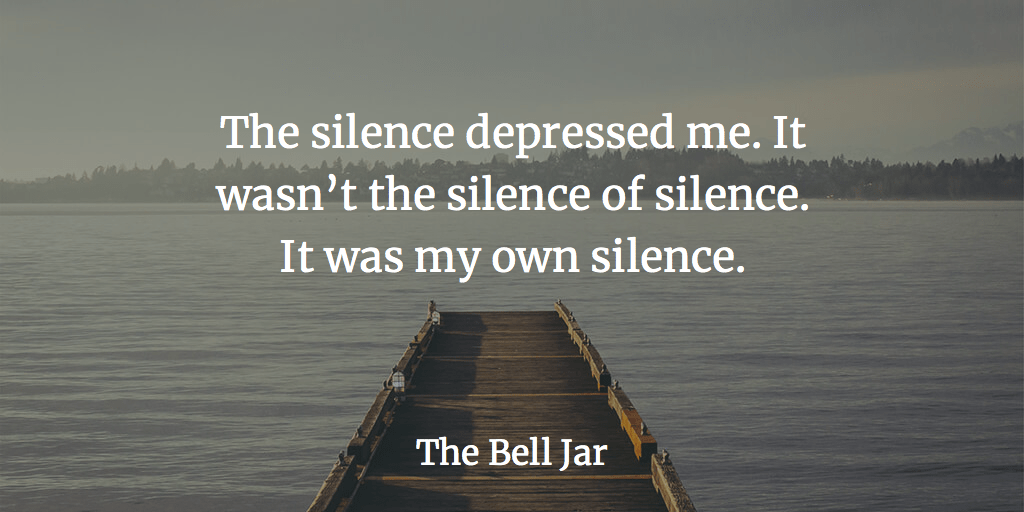
Wonderful though it all was, I’d become addicted to Plath despite reading none of her works in complete. That’s how I came upon The Bell Jar—guilt-ridden and hungry to prove to myself that I know the author I adored.

Before flipping through its pages, I didn’t know what to expect from The Bell Jar. Wanting to figure it out for myself, I read none of the reviews and asked no one I know what they thought of the story. As I began reading, I grew fascinated by the protagonist of the story, Esther Greenwood. The reason, I later realised, is that she’s in no way special. Unlike many other protagonists with their exceptional talents shining through print, Esther was simple in all sense.

The book opens with her in the middle of a writer’s scholarship—something I could appreciate as an aspirer myself. Little by little, as the story progressed, I found parts of myself relating to Esther. She reminded me of my deeper self—the unassuming, uninterested self that often prefers solitude, dabbling in self-doubt and incessant imposter syndrome.

It was later that, as the narrative turned to Esther’s psychological issues, I understood that Esther isn’t just me, but she’s every other person, too. Not only was her behaviour characteristic of me, but she was also an embodiment of the natural evolution of the teenage mind.

It’s not easy growing up, and it’s even more difficult when you’re alone and lacking guidance. That’s most of us. That’s Esther.

That’s why it became tough to separate myself from the character. I became so involved in her life that I wanted to see how each day of her life unfolded. As she cringed, so did I. As she ran away from accepting herself, as did I. I followed her every move, her every decision and instinct as if it would all affect my life in a way.

It was as if were in a vortex where Esther—who struggled to find her own way—would guide mine.

By the time I finished the book, I could do nothing but stare at the wall. I felt intense pleasure within me, a silent jubilation. Esther was recovering. She had hope in her life. Although the book didn’t affirm she found her utopia, it hinted toward it. And having gone through her life with her, relating her every moment with mine, I felt as if my own life would be fine after all. It was as if I’d ridden a roller coaster—dizzy and unsure of what I’d face next, weak in the knees with butterflies in my chest—but had come to a secure halt with my entire being intact.

I couldn’t talk about the experience for days after I’d read the book. I didn’t know how I felt, and finding the right words seemed herculean. But as time went by, my feelings also evolved. From seeing myself in Esther, without a conscious effort, I began relating everything I knew of the author’s personal characteristics with that of Esther Greenwood. Then it hit me that the author herself battled with depression and psychological issues. I began to revere Esther as much as I did Sylvia. And my respect for the writer increased when I understood that she had manifested herself in Esther, giving readers a hint of what she herself was going through during her lifetime.

What a wonderful way to express oneself. Also, a little sad.

Zorba: The unlikeable yet likeable

Zorba

You don’t often come across a book that inspires, confuses, and offends you at the same time. Zorba the Greek did all of that and more to me. Though I’d heard of the title before, I only pursued it because my brother recommended it. He’s not an avid reader, and so since he cherishes it, I guessed I would too.

Through the first few pages, I started to get bored. It seemed like any other fiction — a writer and his friend travelling abroad. It wasn’t clear where they headed or what they intended to do there. My only impetus to keep reading was the hope that a flash of interest would hit me as I turned some page. That page didn’t come for a long time, and I slacked in the mean time. Other priorities came up, and some days I just fell asleep even before opening the book.

It didn’t help that I was reading a misaligned PDF on a digital device. After eight hours at work, the idea of staring at the screen didn’t excite me. Regardless, I snuck in at least an hour on most days. Needless to say, it took me longer to read this than any other book. But that’s not because of these petty situations.

The real reason — I realised later — Zorba took me longer than I’d expected is because Zorba is an idiot. I couldn’t get my head round to like his weird personality that a world of avid readers adore. I hated him. Everything he says seemed to trivialise women, casting them as the weaker sex. He insisted on protecting and respecting a woman, and how when a man does all that, she’d offer herself to him like a slave. As if to prove his point, he takes advantage of a lone woman pining for love. He showers her with praises, gifts, and sweet talk until she falls in love with him and croons for marriage. I felt disgusted. And I couldn’t help but wonder why literature celebrates such an egomaniacal character.

As I read on, however, I realised that he wasn’t bad. Although his speech is fake, his intentions aren’t. As a reader at that point, Zorba’s character evolved so much, displaying an uncanny ability to express love toward the woman he’d seemed to have used. It was only as the story progressed to more aggressive scenes that I understood Zorba reveals his characteristics bit by bit, and it’s almost impossible to assess him midway through the book.

Not only does he express his care for the woman he’d seduced, but he also shows empathy as he fights for and defends another woman who the townsfolk mauled. To me, Zorba then rose from manipulative to compassionate.

While it’s the underlying characteristic I gauged from the narrative, throughout the book Zorba does other little things that hard to hate. Where we speak our mind, Zorba’s unique attraction is that he dances, instead. His playing the santuri, living as if he’d die at any moment, working like a dog, his extensive philosophy of existence—everything of his everyday habits is aspirational to say the least.

“Luckless man has raised what he thinks is an impassable barrier round his poor little existence. He takes refuge there and tries to bring a little order and security into his life. A little happiness. Everything must follow the beaten track, the sacrosanct routine, and comply with safe and simple rules. Inside this enclosure, fortified against the fierce attacks of the unknown, his petty certainties, crawling about like centipedes, go unchallenged. There is only one formidable enemy, mortally feared and hated; the Great Certainty.”

As page after digital page I flipped, I admired Zorba. I still hate that he patronises women and is shameless in thrusting his opinions on others. Regardless, I saw that while Zorba is everything that’s wrong with humankind, he’s also everything that humankind should persevere to become. Not only is Zorba’s character flawed, but it’s also philosophical—a realistic portrayal of human qualities. As I shut the book, I felt as if I’d spent my time in the company of an ordinary human—one who’s good and flawed. In the end I’ve acquired the ability to see through both qualities in Zorba, and still respect him for himself. It’s as if I now can discern the difference between an opinion and the person who holds that opinion. After all, opinions change, people often don’t.